

This research is general operational information, not legal, tax, accounting, employment, benefits, privacy, medical, or cybersecurity advice.
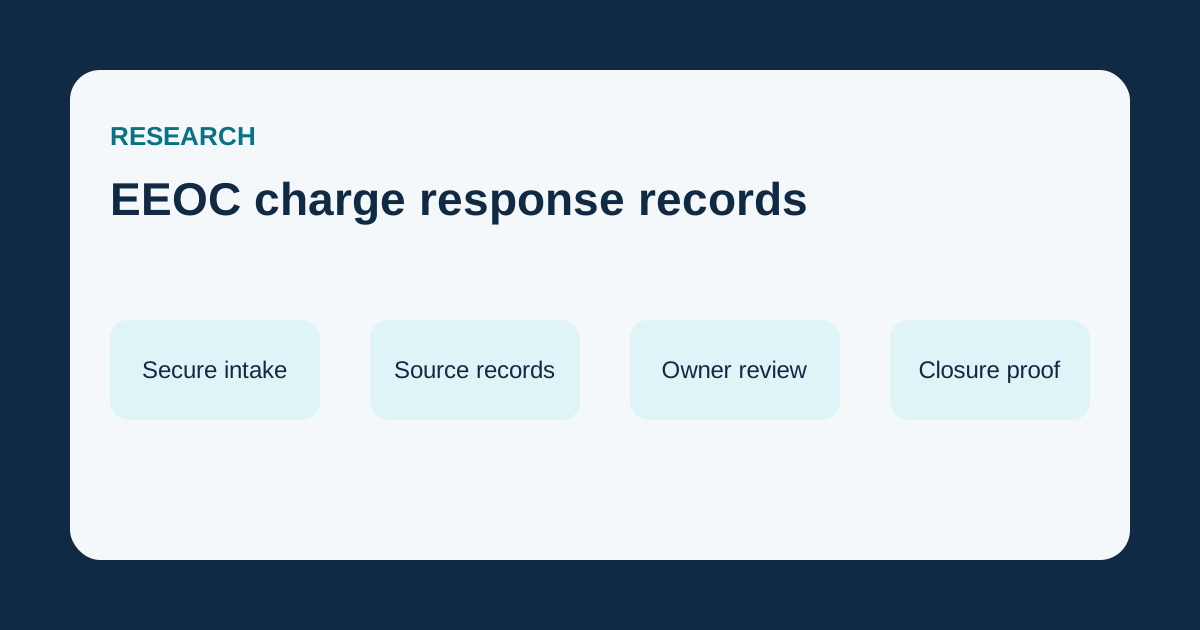
An EEOC charge creates measurable coordination work when a business can trace one notice through secure intake, record collection, authorized review, portal submission, follow-up requests, and closure. Case count alone does not measure the effort or authorize an administrator to shape the employer's legal response.
Three numbers that frame the study
- One charge is one case, even when it produces many messages.
- The source register contains ten authoritative references.
- Current EEOC respondent guidance generally describes a 30-day position statement window.
Start with the agency record
Record the notice date, portal access owner, charge identifier, response owner, requested materials, due date shown by the agency, and any mediation invitation. Store the notice and case materials in a restricted location. Do not copy allegations or sensitive employee information into an open task board. The study clock begins when the organization receives the agency notice, not when somebody forwards it to HR. Record the delay between those events because it reveals whether mail and portal ownership are dependable.
| Charge record | Administrative test | Owner question |
|---|---|---|
| Notice and charge | Receipt and secure filing are reproducible | Who is authorized to respond? |
| Evidence index | Every requested item has a custodian | What may be disclosed? |
| Submission copy | Filed material matches approval | Is the legal position final? |
| Portal history | Requests and confirmations are retained | Does counsel need to act? |
Build the evidence index around allegations
Build an index that points to approved source records without rewriting them. For each requested item, record the system owner, date range, retrieval date, reviewer, confidentiality label, and disposition. Preserve the exact submitted file set and the portal confirmation so the business can distinguish preparation from final approval. Organize the index by the agency request and the employer's authorized response structure. Do not create a broad employee dossier merely because records are available. A focused index reduces unnecessary disclosure and makes missing evidence visible to counsel.
Use separate status values for requested, located, withheld for owner review, approved, submitted, and superseded. Confidential attachments need their own labels. If an amended charge arrives, preserve the earlier scope rather than rewriting history.
Measure custody failures and reviewer waits separately
Classify missing custodian, incomplete date range, conflicting source record, confidentiality question, privilege question, portal access failure, amended charge, new agency request, reviewer delay, and missing submission confirmation. Retrieval minutes belong to the record system or custodian. Time after the packet is complete belongs to the authorized reviewer queue. Portal follow-up, confirmation filing, and controlled correspondence are administrative work.
Sample at least one closed charge and every open charge in the period. Reconcile the tracker with the portal history and the exact submitted files. A completion date without the submitted package cannot prove which evidence left the organization.
Long retrieval time points to record ownership or search problems. Long waits after a complete packet point to qualified reviewer capacity. Repeated portal and evidence packaging work that remains after those defects are corrected is the administrative demand to compare with available HR coordination hours.
Keep legal judgment with the response team
Administrative support can secure notices, maintain the case register, retrieve authorized records, assemble reviewer packets, track portal events, and retain submission evidence. Employer leaders, HR, counsel, insurers, and authorized representatives decide legal positions, mediation, privilege, confidentiality, factual representations, settlement, and submission approval. HR administration support can maintain the controlled record. The employee record request study provides a useful comparison, while ERISA document request research covers a different disclosure regime.
Source method and conclusion
The ten-source register combines current EEOC employer instructions, portal procedures, investigation practices, recordkeeping material, and privacy guidance. It supports a case-control method, not a national handling-time benchmark. Count secure coordination only after separating source defects and legal review. Contact HireBackOffice to define that bounded administrative layer.
FAQ
What does this EEOC charge response record workload study measure?
It measures verified administrative handling, owner wait, rework, exceptions, and closure evidence for one EEOC charge tied to the agency notice, named response owner, requested records, approved position statement, separately labeled confidential material, portal confirmation, later requests, and closure state. It does not decide the underlying legal, tax, payroll, benefits, or agency question.
Can a virtual assistant make the final decision?
No. Administrative support can secure notices, maintain the case register, retrieve authorized records, assemble reviewer packets, track portal events, and retain submission evidence. Employer leaders, HR, counsel, insurers, and authorized representatives decide legal positions, mediation, privilege, confidentiality, factual representations, settlement, and submission approval.
When should a business repeat the study?
Repeat it after source, access, procedure, and ownership defects are corrected. The second baseline is more useful for staffing because it isolates recurring administrative work from avoidable rework.
Sources
- EEOC, what to expect after a charge is filed
- EEOC small business charge guidance
- EEOC respondent position statement procedures
- EEOC Respondent Portal user guide
- EEOC Digital Charge System questions and answers
- EEOC resolving a charge
- EEOC quality practices for investigations
- EEOC recordkeeping requirements
- NIST Privacy Framework
- FTC guide to protecting personal information