

This research is general operational information, not legal, tax, accounting, employment, benefits, privacy, medical, or cybersecurity advice.
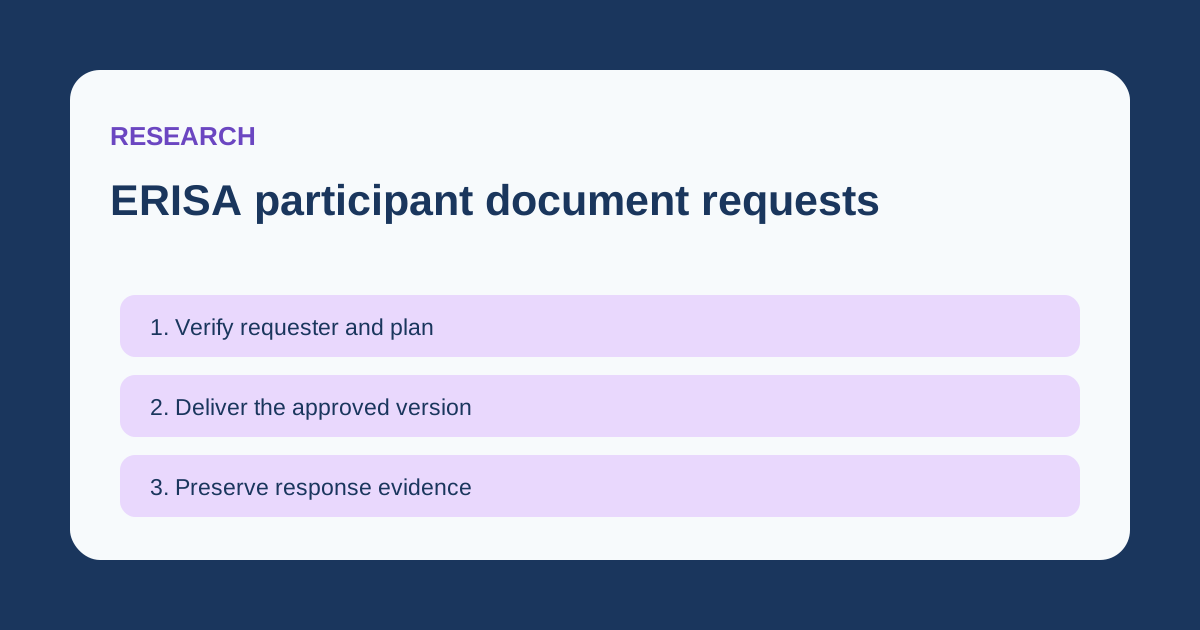
ERISA participant document requests create measurable coordination work when each request has an authenticated requester, clearly identified materials, an authorized disclosure decision, delivery evidence, and a closed exception trail. Request volume alone does not determine what must be disclosed or who may receive it.
Define the requested document before searching
Use one participant or beneficiary request tied to requester verification, requested plan materials, applicable plan and period, decision owner, approved document set, delivery route, delivery evidence, exception history, and closure. Begin with the request as received. Do not silently broaden a request for a summary plan description into an export of every benefits file, and do not substitute a current document when the requester named an earlier plan year.
Capture the request as received, requester name, approved verification result, plan, requested materials, date range, contact route, decision owner, and response due date set by that owner. Keep personal data and plan records in approved storage rather than the coordination log. The response owner should identify which documents belong in scope and the approved delivery route. Administrative staff can then retrieve named materials without interpreting participant rights.
Test version control at retrieval
| Retrieval question | Proof | Exception |
|---|---|---|
| Which plan and year? | Request mapped to approved plan identity | Ambiguous or merged plan history |
| Which version? | Effective date and amendment trail | Superseded copy found first |
| Who approved release? | Named decision owner and decision time | No disclosure authority |
| What was delivered? | Exact file list and secure delivery evidence | Link expired or delivery failed |
Build a delivery index with the approved document name, plan year, version, source owner, approval, delivery channel, sent time, and confirmation. If a requested item is unavailable or disputed, preserve the exception and route it. Do not silently substitute a similar document. Hashes or controlled document identifiers can help distinguish versions when the storage system supports them. The working queue should use safe references instead of copying participant data or plan contents into status notes.
Measure the request path, not page count
A hundred-page document retrieved cleanly can require less work than a missing two-page amendment. Record authentication handling, search time, version comparison, owner review, delivery preparation, failed delivery, and reopenings. Page volume is descriptive, not a capacity measure.
Classify requester verification gap, ambiguous plan, wrong plan year, superseded summary, missing amendment, restricted personal data, privilege question, delivery failure, disputed completeness, and reopened request. Sample delivered cases against the source repository. Also sample requests closed without delivery so the study does not ignore scope, identity, or owner decisions.
Frequent wrong-version retrieval points to document control. Delays after a complete set point to disclosure review. The stable intake, retrieval, indexing, delivery, and evidence work that remains is the administrative demand to compare with benefits capacity. A high wrong-version rate points to records governance. Unclear plan identity points to the intake form or benefits master. Only the remaining repeatable request coordination belongs in a staffing baseline.
Separate plan requests from other records
Administrative support can authenticate and log requests, retrieve owner-approved plan materials, maintain delivery evidence, route exceptions, and preserve the response record. Plan administrators, fiduciaries, benefits owners, privacy owners, and counsel decide requester rights, required documents, timing, redaction, privilege, disclosure method, and response approval. The employee record request study addresses personnel records, not plan disclosures. The benefit claim appeal study addresses decision-case records. HR administration support can handle approved routing across these boundaries.
Research basis
Ten DOL, eCFR, NIST, and FTC sources support the document-control and privacy framework. They do not resolve a particular request. Preserve the request, approved version, delivery trail, and exceptions so the plan team can audit its own process. Contact HireBackOffice to define the recurring coordination steps.
FAQ
What does this ERISA participant document request workload study measure?
It measures verified administrative handling, owner wait, rework, exceptions, and closure evidence for one participant or beneficiary request tied to requester verification, requested plan materials, applicable plan and period, decision owner, approved document set, delivery route, delivery evidence, exception history, and closure. It does not decide the underlying legal, tax, payroll, benefits, or agency question.
Can a virtual assistant make the final decision?
No. Administrative support can authenticate and log requests, retrieve owner-approved plan materials, maintain delivery evidence, route exceptions, and preserve the response record. Plan administrators, fiduciaries, benefits owners, privacy owners, and counsel decide requester rights, required documents, timing, redaction, privilege, disclosure method, and response approval.
When should a business repeat the study?
Repeat it after source, access, procedure, and ownership defects are corrected. The second baseline is more useful for staffing because it isolates recurring administrative work from avoidable rework.
Sources
- DOL Employee Retirement Income Security Act
- DOL retirement plans and ERISA questions
- DOL forms and document requests
- DOL obtaining employee benefit documents
- DOL reporting and disclosure guide
- DOL group health plan fiduciary responsibilities
- DOL meeting fiduciary responsibilities
- Electronic Code of Federal Regulations, ERISA reporting and disclosure
- NIST Privacy Framework
- FTC guide to protecting personal information