

This research is general operational information, not legal, tax, accounting, employment, benefits, privacy, medical, or cybersecurity advice.
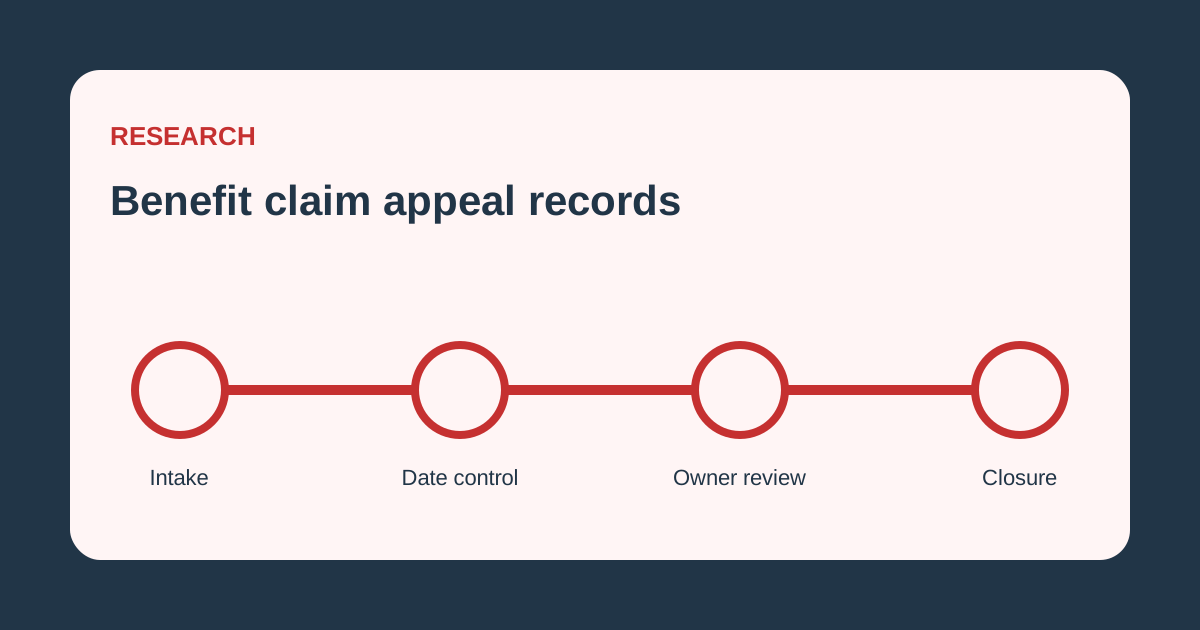
Benefit claim and appeal records expose coordination demand when one case can be followed from secure intake through deadline control, record collection, independent review routing, authorized notice, delivery, and closure. Case volume does not establish eligibility, coverage, medical judgment, or the correct outcome.
Time starts with a classified receipt
Use one claim or appeal case tied to the intake record, claim type, plan procedure, requested information, decision owner, relevant documents, authorized determination notice, delivery evidence, review level, and closure. Current DOL material describes different review periods for urgent-care, pre-service, and post-service appeals, including cited maximums of 72 hours, 30 days, and 60 days in specified circumstances. The plan's qualified owner must classify the case and determine the controlling procedure.
Record the receipt time, approved case reference, claim type, plan procedure owner, participant contact route, requested information, and deadline supplied by the qualified owner. Urgent handling must follow the plan's approved path. An administrator should not infer urgency or medical necessity from incomplete records. Record the exact receipt channel and time because a late internal handoff can consume the review period. Keep health and disability details in restricted systems, with only a safe case reference in the workload queue.
Assemble a review record without judging it
Index the relevant plan provisions, original determination, claimant submission, requested records, reviewer assignment, expert materials when applicable, approved notice, delivery result, and next review state. Keep medical and personal data out of broad trackers. Use safe references that authorized reviewers can follow.
| Case event | Coordination evidence | Decision boundary |
|---|---|---|
| Claim or appeal received | Timestamp and approved identifier | Classification and applicability |
| Information requested | Named item, sender, and receipt state | Whether information is necessary |
| Reviewer assigned | Independence and handoff record | Merits and medical judgment |
| Notice approved | Exact approved version | Reasons and plan interpretation |
| Delivery completed | Channel, time, and result | Further review rights |
Use clocks that pause only when authorized
Track administrative handling and owner review as different durations. If the procedure permits or requires an information request, record who authorized it and how the case clock is treated. The coordinator should never invent a pause state to make an aging report look current.
Classify unclear claim type, missing denial notice, incomplete participant submission, wrong plan version, relevant-document request, reviewer independence question, medical judgment handoff, delivery failure, external review handoff, and reopened case. Review urgent, ordinary, reopened, and externally referred cases separately. A single average can hide the operational demands of urgent handling or repeated incomplete packets.
Find the cause of avoidable touches
Repeated missing notices or wrong plan versions point to process defects. Complete files waiting for qualified review point to reviewer capacity. Stable secure intake, date control, packet assembly, delivery tracking, and evidence retention can support a bounded administrative role. Missing denial notices suggest an upstream output problem. Wrong plan versions suggest document control. Repeated handoffs between reviewers may indicate unclear ownership rather than insufficient administrative capacity.
Count secure intake, approved correspondence, date maintenance, named-record collection, delivery tracking, and archival work after those defects are addressed. Do not count medical or coverage analysis as support hours.
Protect the adjudication boundary
Administrative support can secure intake, maintain dates and status, collect named records, route packets, record authorized notices, and retain delivery evidence. The plan, claims administrator, fiduciaries, medical or vocational professionals, benefits owners, and counsel decide eligibility, coverage, medical judgment, claim outcomes, appeal outcomes, external review, and required notice content. Benefits enrollment exception research covers enrollment records rather than claims. ERISA document request research covers plan material requests. HR administration support can coordinate authorized steps without deciding outcomes.
Source and method note
The ten-source register combines DOL claims guidance, the governing eCFR provision, ERISA material, CMS external-review information, and privacy controls. The cited periods are not universal promises. Use the procedure that applies to the plan and facts. A reliable workload baseline follows the case clock, preserves the authorized notice, and keeps judgment with qualified reviewers. Contact HireBackOffice to scope the administrative layer.
FAQ
What does this employee benefit claim appeal record workload study measure?
It measures verified administrative handling, owner wait, rework, exceptions, and closure evidence for one claim or appeal case tied to the intake record, claim type, plan procedure, requested information, decision owner, relevant documents, authorized determination notice, delivery evidence, review level, and closure. It does not decide the underlying legal, tax, payroll, benefits, or agency question.
Can a virtual assistant make the final decision?
No. Administrative support can secure intake, maintain dates and status, collect named records, route packets, record authorized notices, and retain delivery evidence. The plan, claims administrator, fiduciaries, medical or vocational professionals, benefits owners, and counsel decide eligibility, coverage, medical judgment, claim outcomes, appeal outcomes, external review, and required notice content.
When should a business repeat the study?
Repeat it after source, access, procedure, and ownership defects are corrected. The second baseline is more useful for staffing because it isolates recurring administrative work from avoidable rework.
Sources
- DOL filing a claim for health benefits
- DOL benefit claims procedure regulation guide
- DOL group health and disability claims procedure
- Electronic Code of Federal Regulations, benefit claims procedure
- DOL retirement plans and ERISA questions
- DOL Employee Retirement Income Security Act
- DOL group health plan fiduciary responsibilities
- CMS federal external review process
- NIST Privacy Framework
- FTC guide to protecting personal information