

This research is general operational information, not legal, tax, accounting, employment, benefits, privacy, medical, or cybersecurity advice.
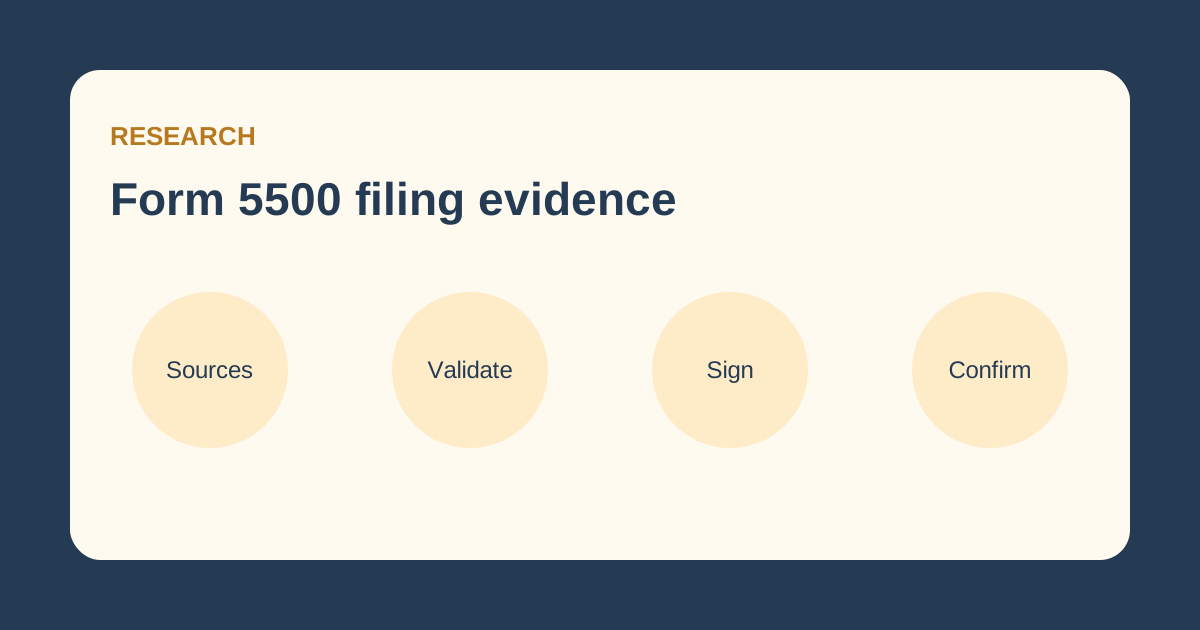
Form 5500 preparation becomes a useful capacity signal when one plan-year filing can be traced through approved source records, schedules, validation exceptions, signer review, transmission, and retained confirmation. The filing count alone does not reveal the preparation work or determine what a plan must report.
Treat the plan year as the container
Use one plan-year annual return package tied to the plan identity, approved source data, applicable schedules, validation results, authorized signer, electronic submission, filing status, and retained signed copy. The IRS Form 5500 corner describes the general due date as the last day of the seventh month after plan year end, but the authorized plan team must determine the date and filing path that apply. Put that approved date on the filing calendar with preparation, review, signature, and submission milestones.
Reconcile the identity block before schedules
Open the annual package with the plan name, plan number, employer identifier, plan year, filing owner, preparer, expected schedules, prior filing reference, and approved data owners. Treat the prior filing as a comparison source, not permission to repeat a value without current review. A changed employer identifier, plan number, name, or plan characteristic can affect the entire package. Resolve that identity exception before staff copy prior-year values into schedules.
| Package component | Preparation evidence | Stop condition |
|---|---|---|
| Plan identity | Approved current master and prior return | Identifier conflict |
| Schedule list | Owner confirms expected attachments | Filing scope unclear |
| Source values | Dated extract with named custodian | Totals do not reconcile |
| Signature record | Authorized signer and exact version | Draft changed after approval |
| EFAST2 result | Submission state and retained copy | Error or missing confirmation |
Use validation errors as operational data
Maintain a field and schedule checklist that names the source, owner, as-of date, validation result, exception, and approval state. Keep signer authorization, the exact filed return, attachments, transmission result, and signed record together. A draft marked complete is not a filed return. Record each validation message against the field, schedule, source owner, correction instruction, and retest result. Do not let the preparer invent a value simply to clear an error. That action would hide both the source problem and the decision owner.
Group exceptions as plan identity mismatch, changed employer identifier, missing schedule, participant count difference, incomplete financial source, validation error, unsigned record, rejected transmission, amended filing question, and missing retained confirmation. Track how often a package returns to a data owner, preparer, signer, or filing service. The handoff count shows where coordination accumulates more clearly than a single total duration.
Read the annual cycle without overstating it
Repeated mapping errors call for a source-system repair. Late complete packets point to owner or signer capacity. The recurring collection, checklist, validation, status, and evidence work left after those causes are addressed is the administrative workload available for a bounded support role. Compare two periods only when plan scope and filing responsibilities are reasonably similar. One difficult filing does not establish a permanent role, and a clean transmission does not prove that source collection was efficient.
The study should report source assembly hours, exception handling hours, signer wait, transmission rework, and archive completion. Keep judgment time outside the administrative total. That separation lets a plan sponsor test whether recurring preparation can be delegated safely.
Authority stays with plan owners
Administrative support can assemble approved plan records, maintain a filing checklist, route validation exceptions, track signatures and transmission states, and retain filing evidence. Plan administrators, fiduciaries, service providers, accountants, counsel, and authorized signers decide filing obligations, schedules, values, representations, amendments, and certification. See HR administration support, retirement contribution exception research, and ERISA document request research for adjacent but distinct workflows.
Methodology
The ten sources include DOL, EFAST2, IRS, GAO, and National Archives material. They define filing, signature, validation, and record-control context. They do not supply a universal staffing ratio. Preserve the signed package and transmission evidence, then use the measured recurring preparation work to shape a bounded role. Contact HireBackOffice to discuss the workflow.
FAQ
What does this Form 5500 filing preparation workload study measure?
It measures verified administrative handling, owner wait, rework, exceptions, and closure evidence for one plan-year annual return package tied to the plan identity, approved source data, applicable schedules, validation results, authorized signer, electronic submission, filing status, and retained signed copy. It does not decide the underlying legal, tax, payroll, benefits, or agency question.
Can a virtual assistant make the final decision?
No. Administrative support can assemble approved plan records, maintain a filing checklist, route validation exceptions, track signatures and transmission states, and retain filing evidence. Plan administrators, fiduciaries, service providers, accountants, counsel, and authorized signers decide filing obligations, schedules, values, representations, amendments, and certification.
When should a business repeat the study?
Repeat it after source, access, procedure, and ownership defects are corrected. The second baseline is more useful for staffing because it isolates recurring administrative work from avoidable rework.
Sources
- DOL Form 5500 Series
- EFAST2 filing system
- DOL EFAST2 questions and answers
- DOL forms and filing instructions
- DOL forms and document requests
- DOL Employee Retirement Income Security Act
- DOL EFAST2 Form 5500 filing tips
- IRS Form 5500 corner
- GAO Standards for Internal Control
- National Archives records management policy