

This research is general operational information, not legal, tax, accounting, employment, benefits, privacy, medical, or cybersecurity advice.
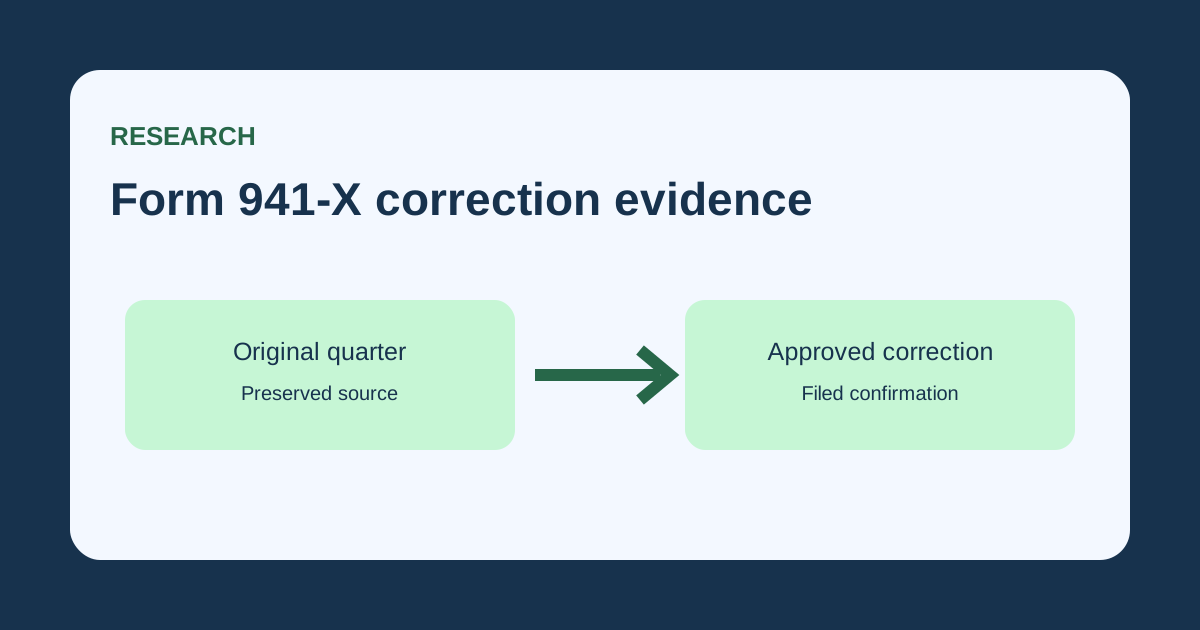
Form 941-X corrections create measurable payroll coordination work when each affected quarter has an original return, approved corrected source, employee evidence when applicable, qualified review, filing state, and retained confirmation. A correction count does not identify the cause or transfer tax decisions to administrative staff.
Follow one quarter from discovery to filing
IRS instructions use a separate Form 941-X for each corrected quarter. That makes one corrected quarterly employment tax return tied to the original Form 941, discovery record, approved payroll source, line-by-line comparison, employee statements or consents when applicable, authorized signature, filing result, and retention record the clean unit for a workload study. A spreadsheet row that blends several quarters prevents a reviewer from tracing certifications, explanations, payments, and filing results.
Open the case with the affected quarter, discovery date, original return, source system, issue owner, affected lines, and authorized reviewer. Preserve the originally filed values. Do not overwrite them with corrected figures or treat a payroll-system note as approval to file. Record whether the discovered issue affects underreported or overreported amounts, but leave process selection to the tax owner. The administrative record should capture the owner's instruction rather than translate tax rules independently.
Build a correction bridge
| Bridge field | Evidence retained | Qualified decision |
|---|---|---|
| Original reported value | Filed Form 941 and schedules | Whether it was wrong |
| Approved source value | Payroll register and owner evidence | Correct amount |
| Difference | Reproducible comparison | Tax treatment |
| Employee evidence | Statement, consent, or approved exception | Required certification |
| Filing result | Exact signed return and acceptance | Response to any IRS issue |
Prepare a controlled comparison showing the original value, proposed corrected value, difference, source record, cause recorded by the qualified owner, affected employee evidence, and review state. Link any Form W-2 or W-2c impact without merging the two correction processes. The detailed explanation should trace to the business records and the qualified owner's approved cause. Generic language may conceal whether the defect came from duplicate wages, mapping, timing, classification, or another source.
Do not mix W-2 and Form 941-X work
A correction may create a related wage-statement question, but it remains a separate governed output. Link the records and owners without treating one form as proof that the other was completed. The Form W-2 correction study covers that adjacent process.
Classify wrong quarter, incomplete original return, source mismatch, affected employee list gap, missing statement or consent, W-2 impact question, amended Schedule B question, reviewer delay, rejected electronic filing, and missing confirmation. Measure source retrieval, employee follow-up, comparison preparation, reviewer wait, filing administration, rejected transmission work, and archive completion separately. IRS instructions generally call for at least four years of employment tax records, while particular records can have different requirements.
Diagnose the payroll operation
A repeated mapping or timekeeping error belongs to system ownership. A complete packet waiting for tax review belongs to reviewer capacity. Recurring source retrieval, comparison, employee evidence tracking, transmission follow-up, and retention can support administrative capacity after those upstream causes are separated. Compare correction causes by payroll source and discovery channel. A concentration in one import or configuration is a repair project. A steady remainder of approved correction packets may justify recurring coordination capacity.
Preserve tax authority
Administrative support can log an identified error, gather approved payroll records, prepare comparison packets, track employee statement or consent evidence, route review, and retain filing confirmation. Payroll, tax, accounting, legal, and authorized employer owners decide whether and how to correct, calculate amounts, select a process, approve certifications, sign, file, and respond to the IRS. Payroll coordination support can keep sources, status, and evidence organized. Payroll recordkeeping research helps teams examine the broader record environment.
Evidence basis
The ten-source set uses current IRS form pages, instructions, employment-tax guidance, recordkeeping material, and the Social Security employer portal. This article reports a local measurement design, not a correction recommendation or expected case rate. Build the bridge for every quarter, verify the filing evidence, and count only the repeatable administrative work. Contact HireBackOffice to scope that work.
FAQ
What does this Form 941-X correction workload study measure?
It measures verified administrative handling, owner wait, rework, exceptions, and closure evidence for one corrected quarterly employment tax return tied to the original Form 941, discovery record, approved payroll source, line-by-line comparison, employee statements or consents when applicable, authorized signature, filing result, and retention record. It does not decide the underlying legal, tax, payroll, benefits, or agency question.
Can a virtual assistant make the final decision?
No. Administrative support can log an identified error, gather approved payroll records, prepare comparison packets, track employee statement or consent evidence, route review, and retain filing confirmation. Payroll, tax, accounting, legal, and authorized employer owners decide whether and how to correct, calculate amounts, select a process, approve certifications, sign, file, and respond to the IRS.
When should a business repeat the study?
Repeat it after source, access, procedure, and ownership defects are corrected. The second baseline is more useful for staffing because it isolates recurring administrative work from avoidable rework.